New book uncovers little-known chapters of Alfara de la Baronia's history
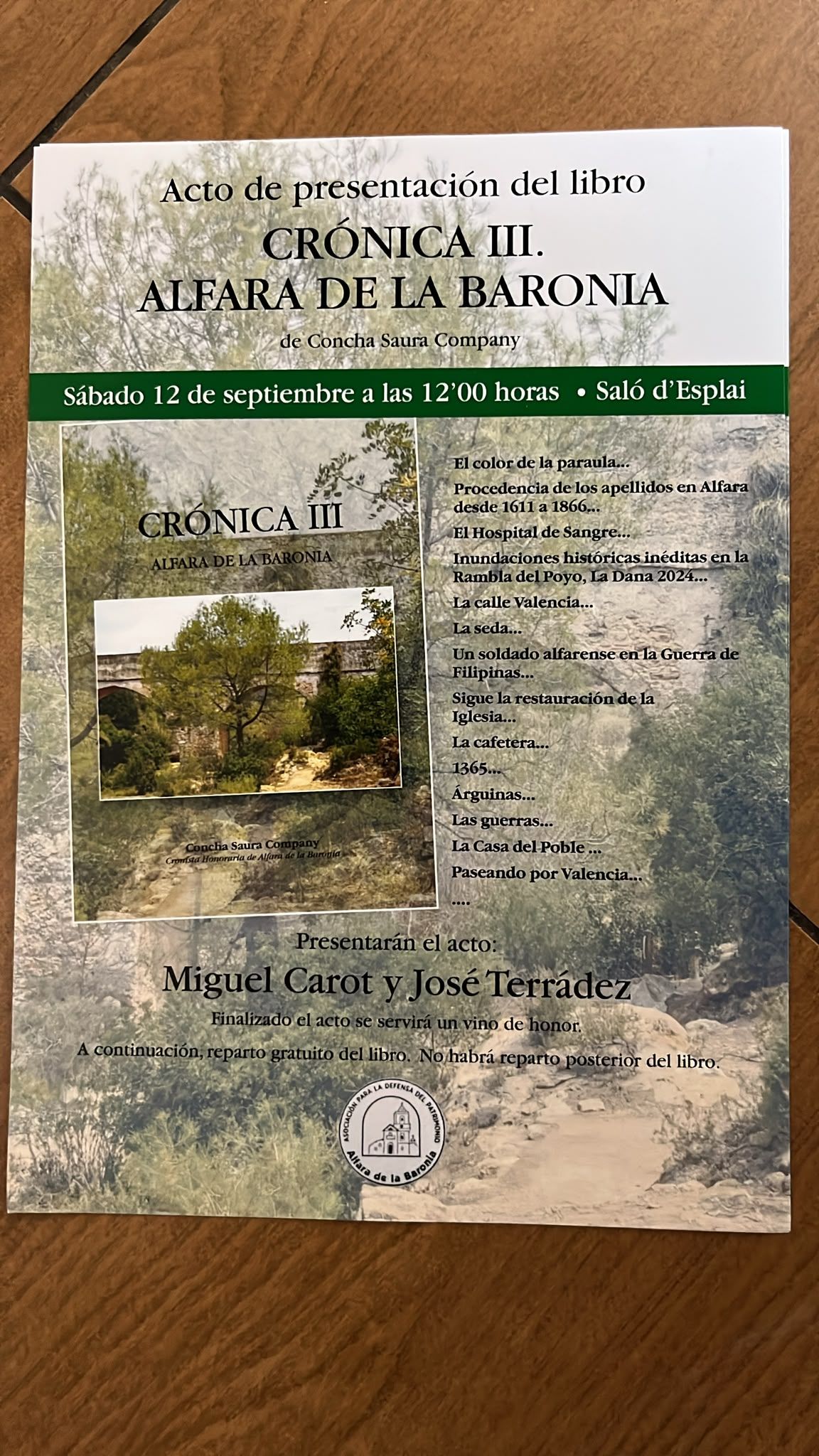
Alfara de la Baronia, a small town in the Camp de Morvedre district, hosts the launch this Saturday of 'Crónica III', local chronicler Concha Saura's new book on the town's history.
A small town, many stories still to tell: that could sum up 'Crónica III. Alfara de la Baronia', the new book by former official town chronicler Concha Saura, to be presented this Saturday 12 September at noon at the Saló d'Esplai. A health issue will keep the author from attending; Miguel Carot and José Terrádez will lead the event instead.
The book is a natural follow-up to 'Crónica II', which Saura published in 2023, and digs into chapters of local history rarely covered in the town's better-known stories: where the surnames many Alfara families carry today came from, what role the town played during the Spanish Civil War, and the journey of a local man who fought on the other side of the world, in the Philippine-American War of the late 19th century.
Alfara's proximity to the so-called "Lines X and Z", the front separating Republican and Nationalist territory during the civil war, forms one of the book's most striking chapters. Saura reconstructs how the old Hospital de Sangre (field hospital), improvised in the basement of the local casino, treated the wounded left by the conflict.
In a very different register, the book also traces a local soldier's path through the Philippine war of the late 1800s: after nearly ten years in the ranks, he fell ill during his time in the archipelago and returned to Alfara, where he spent the rest of his life.
The book also widens its scope beyond the town's borders: it devotes pages to the history of Valencia itself, from ancient times to recent events such as the October 2024 floods, in a journey that ends at Valencia's Museum of Fine Arts, the Pío V. It is rounded off with a literary section, "El color de la palabra" (The colour of the word), featuring poetic and satirical texts set in the town.
One concern Saura raises in the book relates to heritage: the state of Alfara's church, an artistically valuable building that, the book warns, is at risk of deterioration despite occasional work such as restoring a side altar or recently cleaning the bell tower and façade.
The town's own name is part of the history the book highlights: until 15 January 2010, when the regional government approved the change, Alfara was officially called Alfara de Algimia. And the starting point Saura chooses for tracing today's surnames, the year 1611, is no accident: it coincides with the new founding charter the town received that same year, after being left depopulated in 1609 following the expulsion of the Moriscos.
The role of official town chronicler, which Concha Saura held for years in Alfara, is a well-established institution in towns across the Valencian Community: an honorary, usually lifelong position recognising the person responsible for researching and documenting local history, whose work is often compiled into publications like this trilogy, now reaching its third instalment.
The fact that the author herself cannot attend the presentation does not diminish the project: having two fellow residents, Miguel Carot and José Terrádez, take on the task of presenting the book on her behalf reflects exactly the kind of community collaboration that sustains cultural initiatives like this one in the district's small towns.
For readers outside Alfara, these local chronicles also serve a less visible but important purpose: they act as a source for researchers, students or simply curious residents of other Camp de Morvedre towns who want to understand how the major events of Spanish and Valencian history played out at the scale of a small town.
Presentations like this one have become a regular exercise in collective memory across the small towns of Camp de Morvedre, where much of this work falls to local chroniclers and researchers, often working as volunteers.
Projects like this one, almost always funded with modest resources and sustained by the personal commitment of their authors, serve a purpose beyond historical curiosity: they put into writing a memory that would otherwise only be passed down orally, at risk of fading as the generations who lived it firsthand disappear. In a district where a larger town like Sagunto coexists with a dozen municipalities of just a few thousand residents, these chronicles are often the only accessible documentary source for reconstructing everyday life in these towns throughout the 19th and 20th centuries. Similar initiatives have multiplied across the district in recent years, often backed by cultural associations or by the town councils themselves, which see this kind of publication as an affordable way to preserve each town's intangible heritage before it fades with generational change. According to El Periódico de Aquí, with additional data from Wikipedia on Alfara de la Baronia.