Sagunto launches free Spanish course for migrant residents' daily life
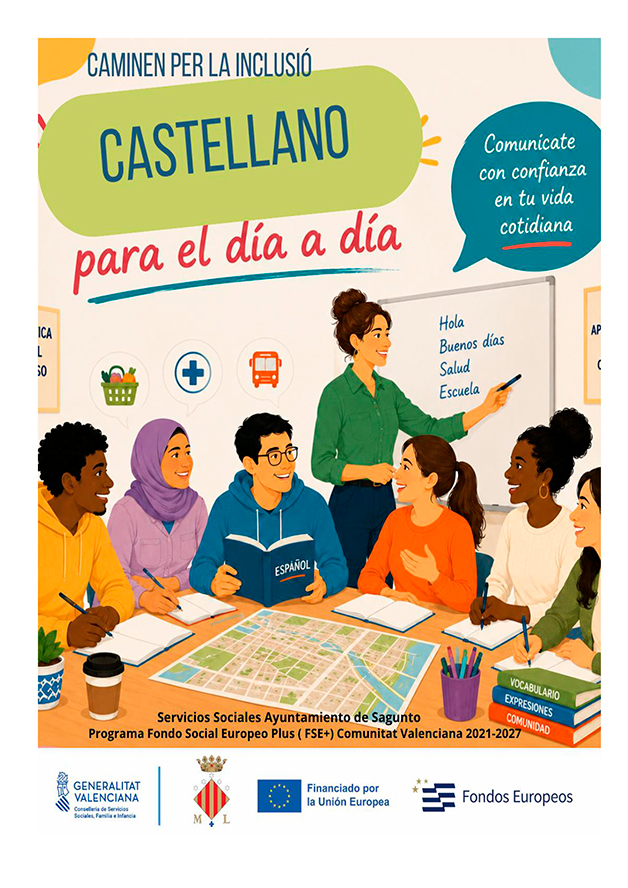
Sagunto's Social Services department has launched 'Castellano para el día a día' (Spanish for everyday life), a free 109-hour course to help migrants become more independent in daily life.
Sagunto City Council, through its Social Services department (Concejalía), has launched a new course under the Social Inclusion Pathways Programme aimed at migrants who do not speak Spanish or struggle to communicate in the language. The project, called 'Castellano para el día a día' (Spanish for everyday life), aims to help this group gain independence in daily tasks.
The course has already started and will run until December 2026, in morning sessions, totalling 109 hours split between theory-practice classes and one-on-one tutoring. The group has 15 participants, a small number the department says allows for close, personalised support.
Programmes like this tend to favour small groups precisely because learning a language for everyday life takes much more than memorising vocabulary: it requires practising real conversations, clearing up specific doubts and building the confidence to communicate without fear of making mistakes. With just 15 students, teachers can adapt the pace to each person's needs — something harder to achieve in conventional language academies (Spanish-language schools) designed for larger groups and more generic content.
Rather than abstract grammar, the course focuses on practical situations: shopping at the market, understanding how the education system works, communicating at the health centre, taking part in local festivals and traditions, and basic digital skills. The idea is that language learning happens alongside real daily life in the town, from grocery shopping to accompanying a child to school.
On finishing the course, participants do not receive an official qualification equivalent to certificates from official language schools, but they do get a certificate of attendance they can add to their personal inclusion pathway — a document that can sometimes prove useful for showing extra training to other social services or employment agencies.
The initiative is funded by the European Union through the European Social Fund Plus (FSE+) Valencian Community 2021-2027, the programme that replaced the old European Social Fund. Across the EU it mobilises a budget of nearly €99.3 billion to strengthen what Brussels calls the European Pillar of Social Rights. Its priorities go beyond language training to include support for young people, reducing child poverty, and promoting gender equality — which explains why a basic Spanish course in Sagunto can draw on funds originally designed for labour and education policy across the whole EU.
For the Social Services department, language is a gateway to other rights: without fluent communication, it is harder to access healthcare, understand a rental contract, follow a child's progress at school, or simply book an appointment at any public office. That is why officials stress the course is not just about vocabulary — it aims to strengthen personal independence and make it easier to access local services.
The course takes place in a town with a notable share of foreign residents, with a strong presence of people from Latin America and North Africa, a context that suggests demand for this kind of training will continue. The department has not ruled out running new groups if the current experience proves successful, although no date has been set for a second edition.
The course adds to other initiatives under the Social Inclusion Pathways Programme, a municipal framework that combines training, social support and job guidance for groups at risk of exclusion. In a town where new industrial plants are attracting workers from elsewhere and their families, Social Services expect demand for this kind of resource — from language classes to help with paperwork — to keep growing in the coming years, which could push the council to expand its training offer beyond this first edition. For migrant families, mastering Spanish does more than ease daily life — it also shapes children's integration at school and families' ties to the town's community and social networks, two areas the council has specifically highlighted when presenting this initiative.
The push for this kind of training comes as Sagunto goes through a fast economic transformation, with new industrial investment attracting both foreign specialist workers and their families. While the Social Services course is not directly linked to these projects, the department acknowledges the town's diversity will keep growing. According to aytosagunto.es, with additional data from the Conselleria d'Educació, Universitats i Ocupació on the FSE+ programme.