Sagunto marks its first Municipal Agriculture Day with tribute to farmers
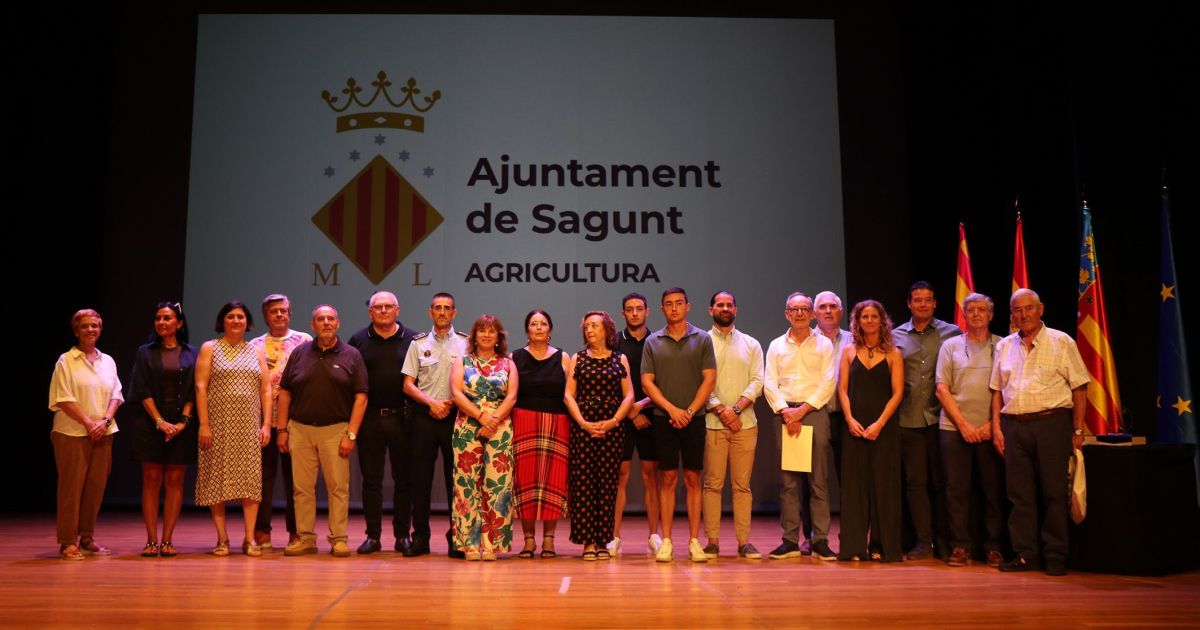
The Joaquín Rodrigo Auditorium hosted Sagunto's first Municipal Agriculture Day on Wednesday, honouring farmers, rural officers and security forces linked to the sector.
A new date has joined Sagunto's institutional calendar: this Wednesday saw the first-ever Municipal Agriculture Day, following a plenary agreement passed in August that permanently fixes the date every 9 September. The Agriculture department organised the event at the Joaquín Rodrigo Auditorium with the stated aim of giving visibility to a sector that coexists — not always with the same media attention — alongside the town's booming industrial transformation.
The choice of venue is no accident. Sagunto picked, for this tribute to farming, the auditorium named after its most universally known son in music: Joaquín Rodrigo, composer of the "Concierto de Aranjuez", born in the town in 1901. Pairing the composer's name with a tribute to the land sums up the event's underlying message well: Sagunto's identity is not confined to industry or Roman heritage — it also includes its market gardens and its farming people.
The most emotional moment came with a tribute to Juan Miguel Soria, a Rural Guard officer who died recently, whose memory joined the recognition given to technical staff and rural officers who retired this year and those still serving today. Several agricultural organisations also received specific mentions during the ceremony: the Comunidad de Regantes (irrigation community), the Sindicato y Jurado de Riegos (irrigation board), ASCOA and the Hunters' Society, along with special recognition for Sagunto's fire station for its support role in rural areas.
Alongside the tributes, the day served as a showcase for two new communication pieces: a short documentary titled "Sagunto, cultivando el futuro" (Sagunto, cultivating the future) and the campaign "Sagunt, la agricultura que hace historia" (Sagunto, agriculture that makes history). The latter draws an explicit line between farm produce and several of the town's heritage symbols — the Roman Theatre among them — as well as the industrial legacy of Puerto de Sagunto, a collection that includes the old Blast Furnace No. 2, the old pier (Pantalán) and the General Workshops sheds.
In her remarks, councillor Ana María Quesada framed the sector's challenge in terms of technological modernisation, resilience and competitiveness, without neglecting environmental sustainability or food security, and called on higher levels of government to match what she said the council itself is doing. Onda Cero Sagunto journalist María José Gimeno hosted the event, which was also attended by deputy mayor María José Carrera, along with representatives of the farming sector and Local Police officers.
Events like this can also grow, over successive editions, into an educational tool: it is not unusual for this kind of municipal commemoration to eventually include school visits to farms or awareness talks at local schools, following the pattern of other sector-specific dates Sagunto already marks, such as industry or Roman heritage.
It is worth recalling exactly what the Comunidad de Regantes is, one of the organisations honoured: a public-law body common in farming areas of the Valencian Community, responsible for collectively organising the distribution of irrigation water among farmers in the same area. Placing this explanation alongside the rest of the event's content helps explain why organisations such as the Comunidad de Regantes, the Sindicato de Riegos (irrigation board) and ASCOA received public recognition: they are the ones responsible, day in and day out and almost invisibly to most residents, for managing water and representing the interests of the local farming sector.
With this first Municipal Agriculture Day, Sagunto formalises a recognition that until now depended on occasional gestures, in a town where farmland increasingly coexists with logistics warehouses, gigafactories and an economy turning toward electric vehicle manufacturing without giving up its farming roots.
Creating this commemorative day is not an isolated gesture: in recent months the council has multiplied institutional events aimed at reinforcing specific sector identities, alongside the economic transformation the town is going through as new industrial investment tied to electric vehicle manufacturing arrives. Setting aside a dedicated date for agriculture reflects, in that sense, a municipal effort to keep industrial growth from overshadowing traditional activities that, while generating fewer headlines, still occupy a significant share of the town's land and landscape. Institutional events of this kind also serve a social cohesion role in a demographically large town, where very different neighbourhoods, outlying hamlets and productive sectors coexist under the same administration and often compete for visibility within the municipal agenda. According to El Periódico de Aquí, with additional data from Wikipedia on Joaquín Rodrigo, Puerto de Sagunto's industrial heritage and the Comunidad de Regantes (irrigation community).