CEV and CEOE Aragón ask Spain to reopen Teruel-Sagunto rail study
Two business federations, CEV and CEOE Aragón, are asking Spain's Ministry of Transport to withdraw its study on the Teruel-Sagunto rail line and reconsider a double electrified track, a decision that affects freight capacity for Sagunto's port and industry.
For Sagunto's port and industrial estates, much of what they can grow into over the coming decades depends on a technical decision now being argued out in Madrid: whether the train line from Teruel will run on a single, non-electrified track or on a double electrified track. Two business federations, the Confederación Empresarial de la Comunitat Valenciana (CEV, the main Valencian employers' group) and CEOE Aragón, its Aragonese counterpart, have jointly challenged the document the Ministry of Transport is using to settle that question: the study on the Teruel-Sagunto rail section, part of the Cantabrian-Mediterranean Corridor, the rail axis linking inland Aragón with Sagunto's port and industry.
The two organisations want the document withdrawn and a fresh assessment ordered that puts the double electrified track back on the table, the option the ministry dropped in July, citing cost, in favour of a single track. Both federations call the ministry's proposal inadequate and argue any review should weigh the role this rail axis will play over the coming decades, not just its upfront cost.
Their underlying objection goes beyond engineering: they argue it is not enough to check whether a single track could handle the demand forecast in the baseline scenario, which is built on 2017 figures already overtaken by business growth in Aragón and the Valencian Community. In their view, any serious planning should also factor in industrial and logistics growth, assume that more and more freight will shift from road to rail, and recognise that the rail network itself, in Spain and across Europe, is going through deep structural change.
Neither CEV nor CEOE Aragón rule out a phased build: they would accept the second track arriving in stages, as long as the necessary land is set aside now and the technical conditions for that future second track are fixed from the start. What they want to avoid is a situation where whatever gets built now, as a single track, has to be dismantled and rebuilt within a few years, at extra cost to public funds.
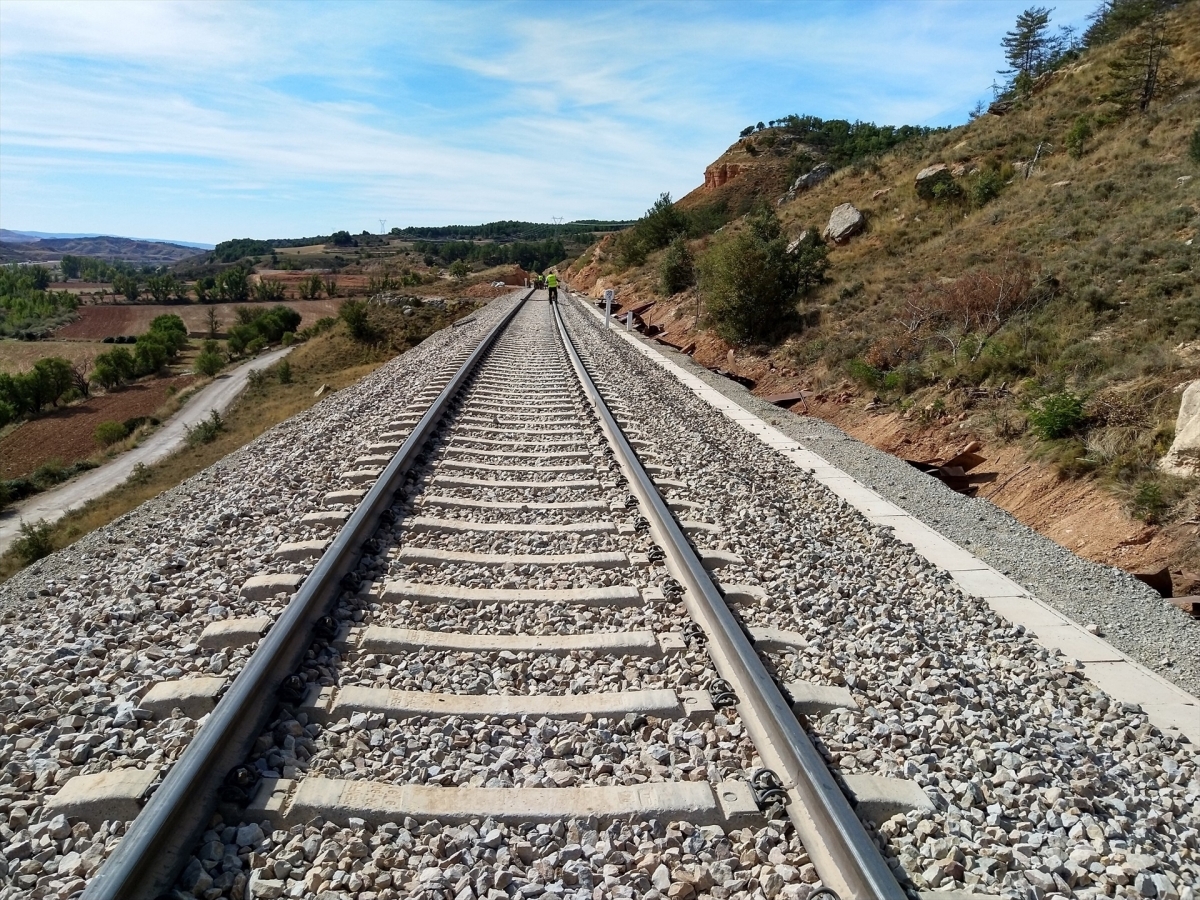
The infrastructure at stake is no small matter: the line that currently connects Zaragoza and Sagunto via Teruel runs on Iberian gauge (the wider track width used across most of Spain and Portugal), has no electrification at all, and runs as a single track for nearly its entire length, exactly the setup both federations want to move away from.
The Cantabrian-Mediterranean Corridor itself, the wider project this section belongs to, is not new either: it was unveiled seventeen years ago, in November 2009, in Zaragoza, with the aim of linking Spain's Cantabrian coast with Valencia through cities including Teruel, Zaragoza, Tudela, Logroño, Miranda de Ebro, Pamplona and Santander. Nearly two decades on, the link to Sagunto remains one of the weakest points along that whole route.
Behind the federations' demand lies a scale that goes well beyond this one section: the corridor runs through six autonomous communities, the Valencian Community, Aragón, Navarre, La Rioja, the Basque Country and Cantabria, which together have around 10.8 million residents and 700,000 companies, generate 21.6% of Spain's GDP, and carry even more weight industrially, accounting for 29.3% of the country's industrial gross value added and 31.2% of its industrial employment. In 2025, that same group of regions handled €193.026 billion in foreign trade, 23.2% of the national total, of which €29.58 billion and more than 40 million tonnes corresponded to trade between the regions themselves.
A second argument concerns consistency within the corridor itself: the Teruel-Zaragoza and Valencia-Castellón-Tarragona sections are both moving towards double track, so leaving Sagunto-Teruel as a single track would, the federations argue, open a capacity gap exactly where the corridor meets the Valencian port system. The risk they flag is that this section ends up acting as a bottleneck, making the Teruel route less competitive against other options and limiting the payoff from other investments already made or planned at both ends of the line.
On top of that there is a more strategic reading: the objection also points to the corridor's dual civilian-and-military use at a time when Europe is pushing defence infrastructure and calling for networks free of bottlenecks with good interoperability. For Sagunto, that bigger debate comes down to something very concrete: the municipality's port and industrial estates, from ArcelorMittal's steel mill to PowerCo's upcoming battery gigafactory, need the railway to carry ever more freight, something a single, non-electrified track is unlikely to sustain in the long run.
For Sagunto residents, how this administrative process ends is not a distant matter: it will determine, over the coming decades, how much freight can enter and leave the city by train instead of by truck, with the knock-on effect that would have on heavy traffic at the entrances to the port and the industrial estates.
According to valenciaplaza.com, with additional background from Wikipedia on the Zaragoza-Sagunto line and the Cantabrian-Mediterranean Corridor.