Sagunto launches Municipal Agriculture Day with a tribute to farmers
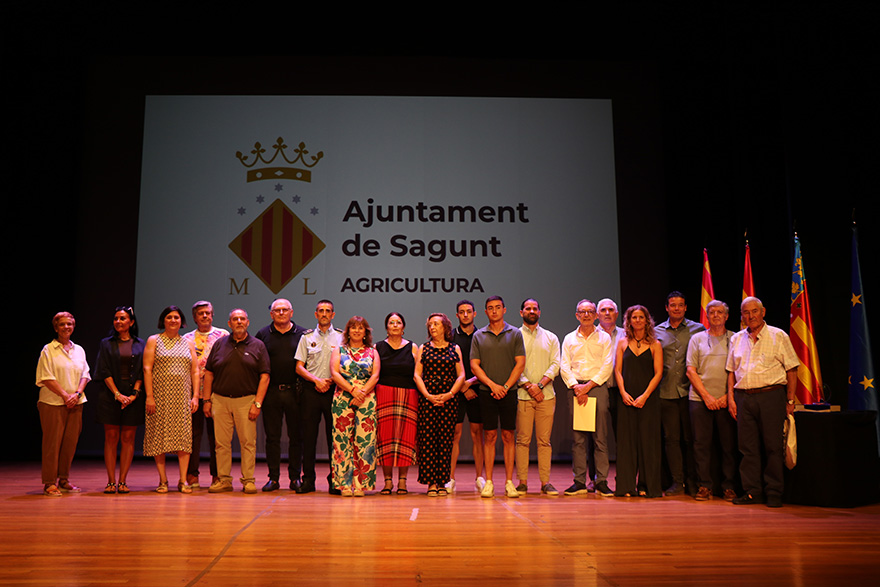
Sagunto City Council held the first edition of Municipal Agriculture Day this Wednesday at the Auditorio Joaquín Rodrigo, a date that coincides with World Agriculture Day.
For the first time in recent history, Sagunto now has a fixed date to publicly recognise the people who work its land. This Wednesday, the Auditorio Joaquín Rodrigo hosted the first edition of Municipal Agriculture Day, an event organised by the Agriculture Department, led by councillor Ana María Quesada, with two linked goals: to highlight what farming contributes to the town's economy, social life and natural environment, and to press other levels of government to add their own support policies for the sector.
Behind this event lies a political decision taken only weeks ago: the City Council plenary session approved, through an official declaration in August, the creation of this new commemorative day in Sagunto. The chosen date is no accident either, since 9 September coincides with World Agriculture Day, meaning Sagunto now adds its own local celebration to a date already marked internationally.
The programme combined professional recognition with personal remembrance. It opened with a tribute to Juan Miguel Soria, a Rural Guard officer (a local corps that patrols farmland) who died recently, and continued with mentions for those who retired this year from the department's technical and rural inspection staff, without forgetting those still working in the department day to day.
Organisations linked to farming also had their moment, grouped here by role rather than by the order in which they were named: on one side, the bodies that manage irrigation water, the Comunidad de Regantes (irrigation users' association) and the Sindicato y Jurado de Riegos (irrigation board); on the other, two sector associations, ASCOA and the local hunting society. A special mention went to the fire brigade, with a nod to Sagunto's own fire station, and a further mention -despite their absence from the room- to the National Police and the Civil Guard, both forces that regularly work across the municipality's rural areas.
The audiovisual side of the day carried as much weight as the tributes themselves. Organisers unveiled a short documentary titled "Sagunto, cultivando el futuro" ("Sagunto, cultivating the future"), together with a communication campaign called "Sagunt, la agricultura que hace historia" ("Sagunt, agriculture that makes history"), designed to pair each farm product with a historic symbol of the town -the Roman Theatre, for instance, or the industrial buildings of Puerto de Sagunto (coastal district of Sagunto)- making clear that farmland carries as much weight in local identity as its monuments.
Journalist María José Gimeno hosted the ceremony in front of a large crowd that included deputy mayor María José Carrera, other council members, professionals from the farming sector and local police officers. Quesada took the floor to praise the sector's resilience and its growing use of technology, summing up the council's commitment in one short line: the City Council "backs the future of farming". The councillor also used the moment to call on higher levels of government for greater support, each within its own area of responsibility.
That symbolic weight farming carries in Sagunto did not appear out of nowhere. The town's farming landscape changed radically just over a century ago: until the 19th century, vineyards were the dominant crop, but phylloxera, a vine disease, wrecked much of the crop in the early 20th century and forced a shift that replaced vines with citrus trees, while also converting dry farmland into irrigated land. The campaign unveiled this Wednesday deliberately draws on that same history to link it with the present.
The launch of this new date also comes as the town goes through a major economic shift, driven by the arrival of the electric vehicle industry and renewable energy. Against that backdrop, setting aside a day for farming is meant to underline that the municipality's other historic pillar -farmland that coexists with industrial estates and new factories- still carries real weight in the landscape, the economy and the daily life of thousands of residents. The Council has already said the event will be repeated every year, with new tributes and a periodic review of local farming policy.
According to aytosagunto.es, with additional background from Wikipedia on the agricultural history of Sagunto.