Marjal dels Moros wetland, near Sagunto, boosts turtle survival rate
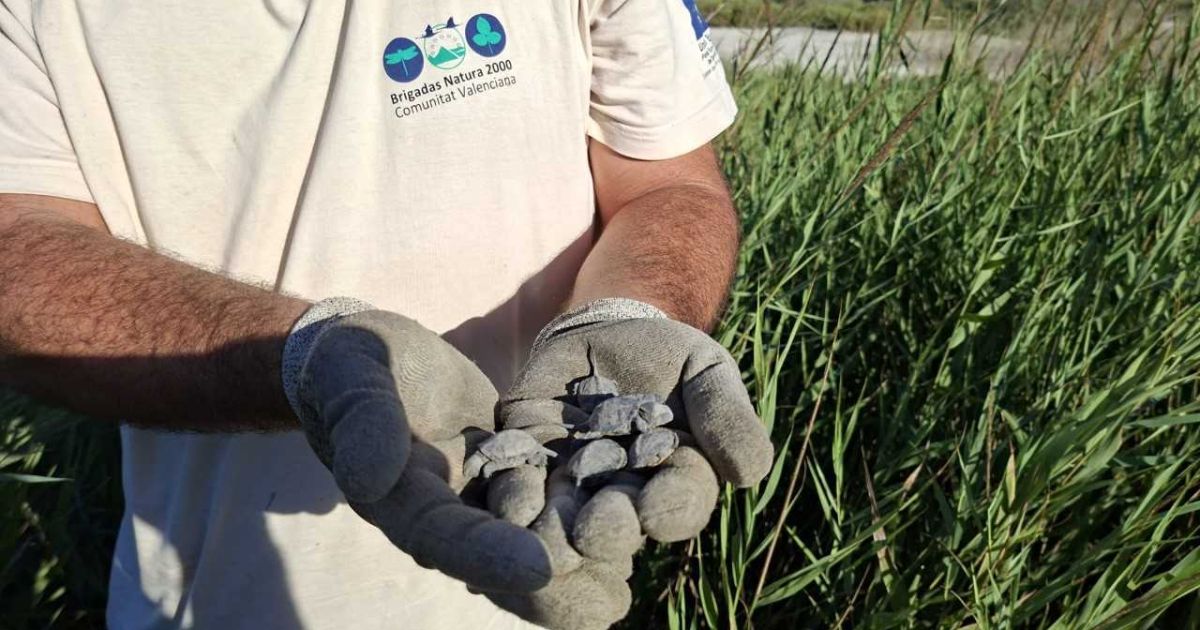
At the Marjal dels Moros wetland, which lies partly within Sagunto's municipal area, Valencia's regional government rescued 61 hatchlings of the European pond turtle this year, raising the species' survival rate from 1% to 40%.
Residents of Sagunto and Puçol who visit the Marjal dels Moros wetland to watch birds or walk along its paths now have one more reason to look closely at the water. The European pond turtle (tortuga d'estany in Valencian), the only native freshwater turtle species in the Valencian Community, is making a comeback in this wetland, shared by both towns. A technical team from the regional government, backed by the public company Vaersa, has gathered 61 hatchlings this year, just out of the egg, to shelter them during the most delicate stage of their lives, when any predator or non-native species could wipe them out.
The species, known scientifically as Emys orbicularis, has been listed as an endangered animal since the 1990s, and its recovery is one of the conservation priorities the regional administration maintains in this natural area. Vaersa (Generalitat Valenciana's public environmental company) is in charge of managing protected Natura 2000 sites across the Valencian Community, including this wetland.
The Marjal dels Moros is not just any wetland: it was declared a Special Protection Area for Birds back in 1996. Since then, this legal status has required extra vigilance over the water habitats that both birds and other wildlife, including the pond turtle, depend on.
The figures explain why the project is considered a success. Seventeen years ago, back in 2009, technicians could locate only a single turtle in the whole wetland. Twelve months ago, by contrast, 26 hatchlings born on their own were already recorded, a sign that adult females are laying eggs normally again in the area. Thanks to the supervised-hatching programme, the share of hatchlings that survive their first year has jumped from 1% to 40%, according to the administration's figures.
The protection system works in several stages. A team locates the nests and covers them with metal-mesh structures to stop predators reaching the eggs. Among those predators, the fox stands out, responsible for a large share of the losses recorded in the area. Once they break out of their shells, hatchlings are moved to centres run by Vaersa and to partner organisations, including the Oceanogràfic aquarium and the Bioparc zoo in Valencia city, where they receive veterinary monitoring until they turn about a year old. Only then are they returned to the wetland, where they grow freely, now bigger and better able to escape predators.
Along with pressure from native predators, there is an added problem: the presence of the red-eared slider (tortuga de Florida), a non-native turtle that competes directly with the pond turtle for the same basking spots and food in the wetland. To track the colony and spot intruders, technicians place several submerged traps around the wetland: when they catch a native turtle, they check it over, mark it with an identification code and release it back into the water; if it turns out to be an invasive turtle, they remove it from the site for good.
Besides working directly with the turtles, the conservation team also clears vegetation by hand in the spots where turtles usually lay their eggs, to leave the ground in better condition for nesting. This work is carefully timed to avoid the season when the birds that also live in the wetland are breeding.
For people living in Sagunto or Puerto de Sagunto (coastal district), the Marjal dels Moros is one of the closest natural spots where they can see this kind of conservation work up close, just a short drive from the town centre. It is rare to be able to follow the recovery of an endangered species with such concrete data in a natural area right on a city's doorstep, which makes this project an example of how native wildlife can bounce back with years of sustained investment. The pond turtle can live for more than 40 years, meaning the hatchlings protected today could keep breeding in the wetland for decades, helping to rebuild a population that was nearly extinct in the area fifteen years ago.
According to El Periódico de Aquí, with additional data from Wikipedia and Vaersa.