Sagunto awards Medal of the City to Falla Luis Cendoya, Pín and Rondán
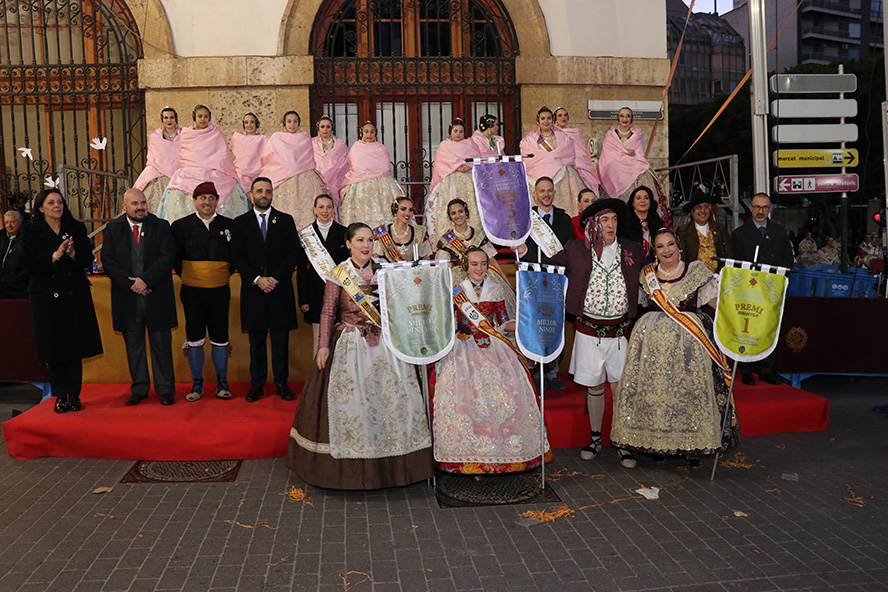
Sagunto's city council agreed to award the Medal of the City to the Falla Luis Cendoya, former MP Margarita Pín and journalist Paqui Rondán, for their cultural, social and festive contribution to the municipality.
Sagunto City Council's September plenary session leaves three names in this year's honours chapter: the Falla Luis Cendoya festival committee, former MP Margarita Pín Arboledas, and journalist Paqui Rondán Martí, all set to receive the Medal of the City (the town's highest civic honour). The three proposals were voted on one by one — each with its own result — and must now go through the usual paperwork: entry in the Municipal Register of Honours and Distinctions, publication in the Province's Official Gazette, and a handover ceremony that, if the council's own regulation is followed, should take place around 9 October, the day marking the Valencian Community. The fact that the same plenary session honours a festival group, a veteran of institutional politics and a media professional all at once shows just how broad the list of merits behind this distinction can be.
This is not a routine award. The Regulation on Honours and Distinctions, in force since 2017, caps how many people can hold each tier at any one time: five for Gold, fifteen for Silver, forty for Bronze. That written limit puts into perspective just how rare this kind of recognition is.
Of the three, the Falla Luis Cendoya is the only one going to an organisation rather than a person. The committee — whose first documented monument, on Calle Poeta Llombart in Puerto de Sagunto, dates back to 1927 — won unanimous backing from the council, which pointed to its weight in Valencian popular culture and its role in shaping the port district's identity. The group itself has always tied its story to the working-class, industrial character of the area, and over almost a century it has picked up awards both for its monuments — the large one and the children's version — and for the illustrated booklets (llibrets) it publishes every year, a literary side of the Fallas that gets less attention but has been recognised just as often. That link to a working-class neighbourhood traces back to Puerto de Sagunto's own history, built up over decades around the steel industry, a past that many Fallas committees in the area still claim as part of their identity.
The second name is Margarita Pín Arboledas, whose record mixes grassroots activism with institutional office. From both sides, she pushed for citizen participation and equality policies, while defending the rights of children, people who need support because of dependency, and other vulnerable groups. Her reach went beyond the town: she sat as a Valencia-province MP in Spain's Congress of Deputies for four terms, from 1996 to 2011, and still keeps an active link with the Institute of Roma Culture. She was also among those who set up the Municipal Women's Council. The votes in favour came from EU-Unides Podem, Compromís per Sagunt, the PP and the PSOE; Vox and Iniciativa Porteña abstained instead. Her profile sums up a style of local politics closely tied to grassroots associations, where time spent in neighbourhood bodies later grows into positions of wider responsibility.
Rounding off the trio is Paqui Rondán Martí, whose career runs across sport, festivals and the media. As an athlete, she was named Saguntina del Año (Saguntina of the Year) in 1994, an award she shared with Mariola Pérez, and later chaired the Club Gimnasia Sagunto gymnastics club. On stage, she took the lead in Sónnoica i Acteón alongside Toni Llorens, with whom — plus Albert Forment — she set up the Acteonica Teatre company in 2018. On the festive side, she was the first woman to give the opening speech (pregón) of Sagunto's patron saint festivities, back in 2001, and has hosted the town's New Year's Eve bell-ringing broadcast in 2022 and 2023. As a journalist, her time at Canal 9, the Valencian regional broadcaster, took in both the evening news and Babalà, a children's show that mixed cartoons, traditional Valencian folk tales and games, on air from 1990 to 2009. Here the yes votes came from EU-Unides Podem, Compromís per Sagunt, Vox, the PP and the PSOE, with Iniciativa Porteña abstaining.
Taken together, this September's plenary shows Sagunto honouring very different paths under the same distinction: a century-old Fallas committee, a political career built around equality, and a profile that has combined sport, theatre and broadcasting for decades. The fact that all three names come up in the same session is not just a formality: it shows the council reading civic merit broadly, ready to reward both the anonymous, collective work of a Fallas committee and individual careers that have left their mark over decades. Source: Sagunto City Council, with additional background from the council's Regulation on Honours and Distinctions and from Wikipedia on the Babalà programme.