Sagunto's Creative Schools programme opens registration on 3 September
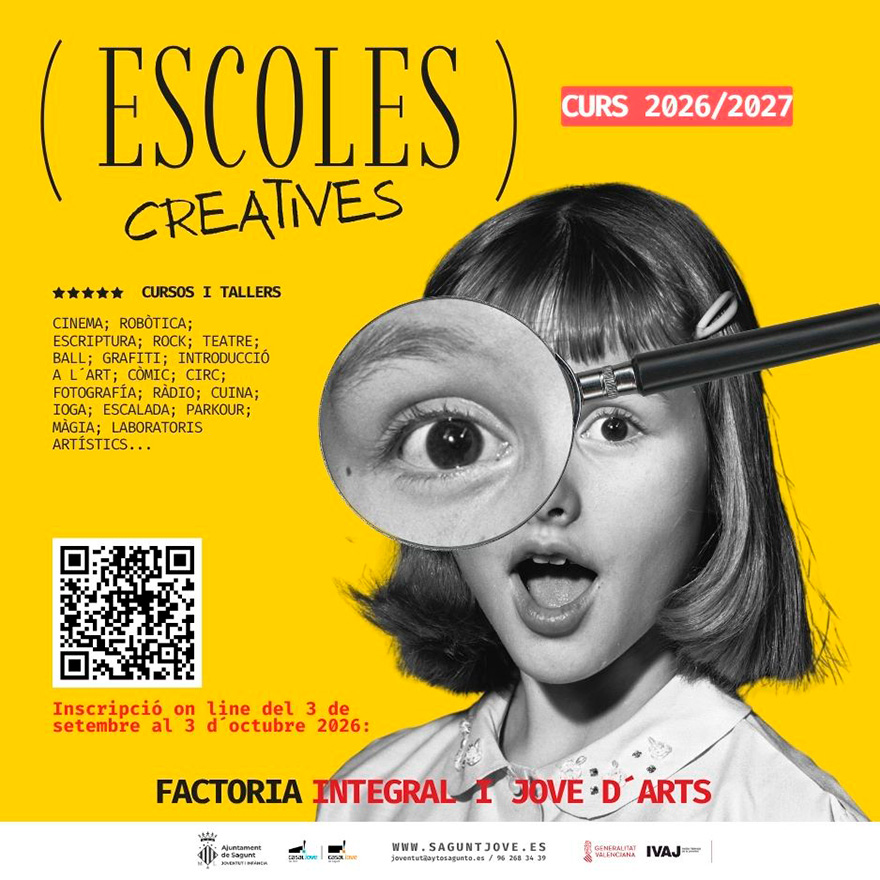
The Youth and Childhood Department will open registration for the Creative Schools programme on 3 September, offering art workshops for children and teenagers at youth centres in Sagunto and Puerto de Sagunto until 3 October.
For families with children looking for an affordable, creative after-school activity, September brings a now-familiar date to the municipal calendar: the opening of registration for the Creative Schools (Escuelas Creativas), the training programme the Youth and Childhood Department runs year after year under its wider Cultura Jove (Young Culture) umbrella. From 3 September the registration window opens, with the workshops themselves starting later, on 13 October, and running until 29 May at the town's youth centres.
The fact that registration opens in the very first week of September is not a small detail. It falls right when many families are already juggling the return to school, buying school supplies, and adjusting work schedules after the summer, so having this information early lets parents plan calmly which activity suits each child, instead of leaving it to the last minute when places may already be scarcer. For anyone hoping to join the Aula de Teatre Jove, whose window lasts just twenty-six days, planning ahead matters even more.
Two separate timelines apply to this call. On one hand, the general registration process stays open until 3 October. On the other, anyone hoping for a place in the Aula de Teatre Jove (Young People's Theatre Workshop) needs to move faster, since that window closes earlier: just from 1 to 26 September. Neither process requires an in-person visit -it is enough to fill in the form on the council's digital registration platform- which simplifies things for families with little free time during the week.
Behind the generic label "art workshops" sits a wide and varied catalogue. There are visual-arts options -introduction to art, comics, photography, graffiti-; performing-arts and music options -theatre, circus, rock music, magic-; an outdoor and physical-activity group -climbing, parkour, yoga-; and finally, creative and reflective disciplines -writing, creative writing, robotics, radio-. This range is a deliberate choice: to cover very different profiles and interests among children and teenagers, rather than sticking to the more conventional options. Most of the programme runs from October to May, alongside shorter, one-off workshop formats for those who would rather try something briefly before committing to a full course.
This mix of disciplines is no accident: by combining artistic creation, physical activity and creative thinking under a single programme, the department gives each child a different way in, based on their own interests, instead of sticking to the more traditional offer of music or painting classes. For families, having a stable, publicly run after-school activity from October to May is also a reliable anchor point when work schedules get reorganised for the new school year, with the added benefit that all the workshops take place within the town itself, with no need to travel elsewhere.
The programme goes beyond the classroom. The department frames the Creative Schools as part of a wider commitment to youth creativity, which includes rehearsal rooms open to music and performance groups, the so-called Lab Creativos (Creative Labs) as an experimentation space, and institutional backing for cultural projects created by young people in the town. The underlying idea, according to the department, is to turn children and teenagers into active agents of local culture -not mere spectators- under what it calls cultural democracy.
Having two separate venues also reflects a deliberate choice about local access: while Casal Jove de Sagunto serves the historic town centre and the inland neighbourhoods, its counterpart in Puerto de Sagunto (coastal district) covers the seaside area, so no family needs to cross the whole municipality to take part in the programme. This dual setup also lets each Casal Jove respond better to the specific demand in its own neighbourhood, even though the general catalogue of disciplines stays the same across the whole town.
Two addresses handle both registration and the workshops themselves: Casal Jove de Sagunto (youth centre, Calle Romeu 8) and its counterpart in the port district, Casal Jove de Puerto de Sagunto (Calle Vent de Marinada). Both centres also take questions in person or by phone before registration is completed: 96 265 58 80 for Sagunto and 96 268 34 39 for Puerto de Sagunto. The website www.saguntjove.es also brings together schedules, the specific content of each discipline, and updated availability of places.
Compared with private academies, where enrolment fees and monthly costs can be a real strain on many household budgets, a publicly run and publicly managed programme like this one tends to be more affordable, and it is also subject to the same educational oversight as the rest of the City Council's education services. That mix of contained cost and institutional backing largely explains why the Creative Schools have become a fixed date on Sagunto's youth calendar, year after year.
In a school year when finding an affordable after-school activity is not always easy, this call for registration offers a public alternative covering nearly nine months, from October to May, with pricing and management centralised through the City Council. According to Ajuntament de Sagunt — Actualidad.